Table of Contents
Ethical Outbound
How to Build Trust with Strangers in B2B
Intro
Outbound Sales often fails.
I’ve watched as a public company was blacklisted by their own Microsoft Exchange server for too much spam, and countless businesses where highly trained, full time SDRs could barely get a meeting per week.
Yet I’ve implemented programs for multiple businesses where the positive reply rate was over 10 percent. (Most industries average 1-3 percent.)
Why such a big gap?
In this report I will try to discern what principles can drive an ethical, effective, scalable cold outbound program.
First Principles
- Never spam
- Only take shots on goal
- Rightsize your audiences
- Match your investment to the upside, not to the tech stack
- Start with things that don’t scale
- Be (obviously) human
Never Spam
The most important principle of Outbound is “never spam.”
There is a very fine line between a cold email and spam.
| Spam | Cold Email |
|---|---|
| Superficial personalization | Personalized to the buyer’s needs |
| Sent for your benefit | Sent for the prospect’s benefit |
| Tells them how great you are | Shows them how great you are |
| Generic; could be sent to 10,000+ people | Specific; can only be sent to<500 people |
| Tracks opens, clicks | Tracks meaningful conversations |
| Marked as spam by many people | Prospects thank you for the message even when they aren’t a good fit |
| Sent by software | Human hits send on every message |
| Sent at 10am Tuesday because statistics | Sent at the best time for your prospect |
| Your software feels expensive | Your software feels like a bargain |
| Your message feels cheap | Your message feels like a 1-1 tailored message |
You know when it is spam. Your prospects know when it is spam.
Don’t send spam.

Only take shots on goal
Most companies start with the assumption that sending email is free, therefore more is better.
“You miss 100% of the shots that you don’t take.”
“Sales is a numbers game.”
“Always shoot your shot.”
This approach matches sports culture in the US, where the scores are high (Basketball) or you are compelled to act (Baseball, Football).
Cold outreach, however, works more like Football (the global kind.)
In Football, like cold outreach, the success rates are fairly low, and there are players dedicated to preventing your shot.

To get a single shot to succeed, you have to get past the goalkeepers:
- An email server looking for reasons why your message might be spam
- Prospect who sees your message and looks for reasons to reject it
A striker who failed to consistently aim for the goal would be quickly benched.
In this context, it becomes more important to optimize for shots on goal, rather than just shots.
A shot on goal, in business, requires two things: track record and relevance.
Track record means you have a proven ability to solve this type of problem. Relevance means the prospect actually has this problem AND the means to act on it.
Consider Elon Musk pitching SpaceX investments. His track record is undeniable, but reaching out to someone who can't afford the minimum investment or has no authority to make investment decisions isn't a shot on goal—it's just a shot.
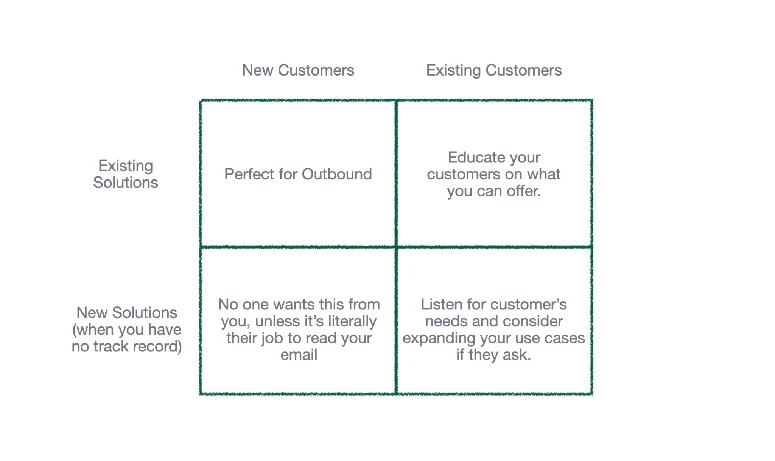
For strangers, you can only establish trust through your existing track record, but you can only convert them if they have both the problem you solve and the intent signals that indicate readiness to act. This is why microsegmentation works: it naturally filters for prospects who show both need and capability to buy.
"What if I don't have an existing track record?"
Serial entrepreneurs love jumping into new domains and building businesses. Unfortunately, this was easier a decade ago. Today, you need a track record. The good news: you already have a track record, it just isn't "solver of [x] problem for this market."
Other ways to get cold meetings:
- Make an industry podcast and invite your prospects on to be interviewed
- Ask them to join your executive advisory board (this requires some industry credibility)
- Invite them to a local private dinner of their peers to compare notes
- Cold email people you already know
- Write a buyer's guide for an adjacent problem space
- Take a role as an investor or advisor in their company
- Publish a manual guide for them to do this themselves (and email the prospects who visit the page)
- Publish the category defining book (and ask them to review a copy before publication)
- Help startups plan interviews for the job that buys your product
- Pitch them by phone or in person
You probably have a track record for something adjacent to your prospect. If you can't do any of these, your best bet might be to get a job in the industry and use that as a platform to connect.
Rightsize your audiences
Most outbound tools want you to create bigger audiences, but the most effective audience will always be a smaller one.
How can you balance these tradeoffs?
- Create buckets of $10M total potential revenue
- Create customer lookalikes
One possible mental model is to look at the total potential revenue of a market rather than the total number of people.
The right market for one SDR is about $10M in potential revenue.
- Hiring a dedicated rep just to become a supplier to Apple? It makes sense if you expect they’ll buy more than $10M
- Selling SaaS at $100k per year? Look for clusters of about 100 buyers
- Selling $10k projects? Clusters around 1,000 buyers might be better
The second model is to simply find customer lookalikes.
Remember, you want to sell existing solutions to new customers. If you don’t have a customer where you’ve solved a problem and written about it, you’ll be hard pressed to find new customers who trust you.
Steps:
- Collect all of your use cases (published and private)
- Cluster customers by similarities that you can identify online
- Search for how many other accounts match these similarities
- If the total market is bigger than $10M, look for more attributes to make it smaller
The ideal segment will
- Match 2+ customers of yours who are willing to talk about your track record
- Include enough prospects to add $1M in revenue if you convert 10% to customers
- Look like a tribe, with similar enough attributes that you know exactly how to write to all of them at the same time
Don’t be afraid of using weird attributes if they help you engage. Here are some real-world examples that worked:
- Toyota Prius (ugly) sold better in liberal cities, but later (less ugly) hybrids Highlander sold better in conservative cities
- Indian offshore services provider found most of their clients have a C-Level or Board Member from India
- Data Science consultant found their best clients are ENFJ marketers who can craft narratives but struggle with the data
- Cybersecurity SaaS discovered their best customers show tattoos on LinkedIn
- LatAm dev shop engaged with prospects who speak Spanish (but are not from the same country)
- Bootstrapped SaaS sold best to industry veterans who value an old school approach to the space
These attributes all succeeded because they indicate compatibility and the data is not obviously obtainable on ZoomInfo. Before AI, all of these campaigns required some faith and a team of researchers; today, your campaigns are only limited by your imagination.
Match your investment to the upside
Done right, cold outbound is one of the most effective programs you can run to generate demand.
Yet for most businesses, this program is an afterthought in their mix.
- The industry standard software, Outreach, costs less than a Salesforce+Gong subscription, and most businesses will stop at Apollo.
- Talent strategy centers on junior reps rather than those with experience relevant to your business
- Few companies have dedicated IT or operations to enable effective programs
This approach works for door to door sales, and it worked well in the era of low interest rates.
In door to door sales, the audacity to knock is the critical skill. Rejection is constant; you need young, optimistic self starters who will continue to put themselves in the position of having a door slammed in their face. And you need a lot of them.
Outbound email, on the other hand, works more like a swarm of door-knocking drones controlled by one pilot. Drones don’t care about the door being slammed on their face. And the bottleneck to success becomes the quality of the drone pilot, who is now responsible for 100x or 1000x more conversations than that previous human door knocker.
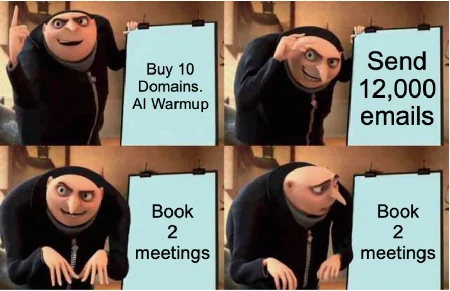
In the low interest rate era, when money was cheap and your startup's valuation was 20x your revenue, you could afford to hire junior SDRs to execute outbound. For a business planning to triple staff in the next year, over-hiring junior SDRs has secondary benefits such as finding talented future marketers, AEs, and customer support staff. At any rate, junior SDRs in such a startup circa 2018 had access to exclusive data sets, which made them more effective than they could ever be working solo.
In the low interest rate era, most SDRs could still book meetings, even without unique email outreach.
This approach does not work for your business.
Whether your company has<$1M revenue or more than $100M, you now have access to the same best in class tools as global competitors who can build and operate at the same scale with 80% lower ROI requirements.
The bottleneck is no longer the technology or the quantity of staff.
You need to invest in the right people, processes, and technology to gain an advantage.
Start with things that don’t scale
Premature optimization is the source of many failures in business.
Cold outbound campaigns enable you to test messages, offers, and audiences at a lower cost than most marketing channels.
Most software in this space encourages you to quickly scale:
- Dedicated email tools like Outreach are intended for larger orgs where managing a junior team is as important as whether your messages work as intended
- Data-centric tools like Apollo make more money when you purchase more data - so they prefer you start campaigns with 10k+ people in a program
The problem with things that scale: someone (everyone) probably already scaled it.
If you have an idea for a campaign that doesn’t scale, that’s a sign that it might still work.
Get the weird data. Try the tiny campaign. If it works? You can probably scale it easier than you think.

Case Study
When I asked to take over outbound campaigns, the CEO made me promise one thing: I wouldn't hire staff until I had run the process myself and found success. In just a few weeks we learned:
- Which competitors were most vulnerable to switching offers
- The technical challenges of using LinkedIn as a system of record
- The UI limitations to Outreach (and how to overcome them)
- Which of my messages were obviously written by a marketer and not by an industry expert (the CEO)
It was painful, but we emerged a month later with winning campaigns. Then we hired for scale.
“Who” matters: Be (obviously) human
The best email marketing of all time might be the Obama campaign, which raised most of its $690 million from direct email.
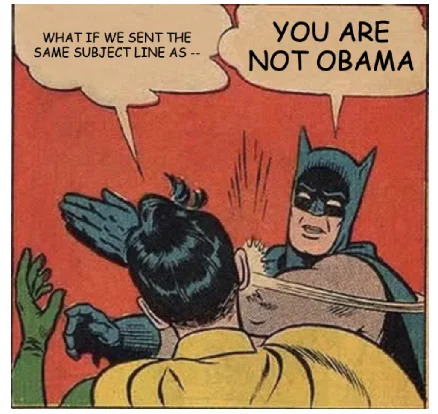
In 2012, email still had some barriers to entry (remote work was still new) so the hurdle was not as high as it is today. Still, the campaign was notable not for the subject lines, but for the source of the email.
I knew about the “Hey” email and its success, but I was surprised to see the variety and prestige of email sender names used to drive donations.
| Subject Line | Source |
|---|---|
| “My place, June 14th” | Sarah Jessica Parker |
| “My uncle Teddy” | Caroline Kennedy |
| “Hey” | Barack Obama |
| “Me again” | Michelle Obama |
| “Saturday night” | Joe Biden |
| “Up late” | Michelle Obama |
| “Wow” | Barack Obama |
Today, the standard is even higher: fewer emails reach the inbox, and your prospects assume they are automated unless you prove otherwise.
The standard practice here is to simply make more accounts and email domains. This increases your deliverability, but it still fails because your email domains are obviously set up for spam.
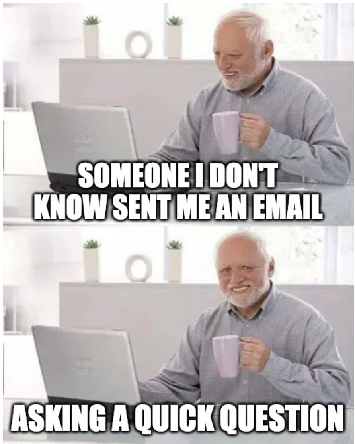
The best practice here is to be more like the “Obama for America” campaign: focus less on the subject line, and more on the human avatar behind the email.
Case Study
I wanted to test the value of the sender, and I had the perfect subject: a summer intern studying at Stanford.
With my encouragement, using her .edu email address, she contacted ten Stanford alumni in my market to ask for a podcast interview. Five said yes; two offered her jobs after the interviews.
Why did this work? In asking for interviews, she wasn't pitching my services, she was addressing their permanent challenge: how to source high-potential talent, from a shared, closed network.
Your sender doesn't have to be higher status: they just need to promise the recipient that they won't waste their time.
Summary
Applying all of the principles above, here is a general strategy and approach to outbound that works for most businesses:
- Don’t spam. You know when it is spam.
- Segment your audience into buckets of $1M-10M in potential revenue, even if this feels small.
- Only send cold outbound to new customers who likely have a need for your existing solutions. (Your niche is smaller than you think.)
- Send emails from someone the prospect would want to talk to, and make sure that person can take over the conversations quickly.
- Write like an expert in the domain, not like a marketer.
- Invest in tools that support an operations pilot, rather than an army of drones
- Go beyond email: seek out the channels that cost money for reach, because your prospects will notice - and your competition might not use them.
- Apply the right level of capital for outbound. It is no longer a free lunch.

Strategy
With the first principles in mind, let’s consider the specific applications to people, process, and technology.
People
Outbound starts with the right people.
A typical outbound org looks like this:
- An SDR manager to train, lead, and motivate the team. Ideally they have 5+ years of experience, and some understanding of the tech
- As many college-grad native English speaking Americans as you can afford
The SDR typically handles three tasks:
- Research accounts and prospects through the datasets you have (LinkedIn, ZoomInfo, Apollo, Google)
- Originate messages to prospects
- Try to personalize every message, while also hitting enough volume to reach their number
This barely worked before AI, but now that AI can personalize messages, the process completely breaks for most industries.
The post-AI org requires domain expertise, IT operations, and some strong researchers or an advanced AI-based deep researcher, all running in parallel.
The modern org emphasizes Senior domain expertise, IT coordination, and long tail junior research. You need:
- An industry insider (can be your head of sales or a founder)
- A GTM Engineer
- A team of deep researchers (offshore or AI Agents)
Case study
I worked with a SaaS business where they had hired two SDRs to start a program, and a very talented manager. Both SDRs came from non-traditional backgrounds, but ready to hustle.
One year in, they had little results to show. They learned the industry, they sent a lot of emails (500+ per week each) but they rarely had meetings. As their anniversary drew near, they both received offers from other SaaS businesses to work as "Senior SDRs" with a 30% pay increase. I quickly agreed to support their departure, and then built a program around these first principles instead.
Industry Insider
Your prospects want to meet with someone from the industry.
Your prospects do not want to meet with the recent college grad who doesn’t know the industry.
You need someone who knows your industry, has the social media presence to prove it, and would be someone your prospects want to take a call from.
Remember the Obama campaign? They sent messages from POTUS, from FLOTUS, and from celebrities like Sarah Jessica Parker.
Your campaigns can be set up by an industry outsider, but you need the language and context that can only be provided by an insider.
In a small business, you may need to go to the top, and engage your CEO or an investor to be the face of your campaign.
Done right, outbound has such high leverage, that it is worth the time of your CEO or investors.
Case study
I was working with a VC that wanted to set up a F500 advisory council to enable better investments. A partner asked me to stand up an outbound campaign targeting one of the most difficult to reach C-level executive titles. I put together comprehensive research, profiling which executives were more likely to desire becoming influencers, which ones were active on LinkedIn, etc. along with personalized messages for each.
The partner then ignored my messages, and wrote a two sentence outreach for each person with the most unprofessional signature I've ever seen. He actually spelled thanks as "thks". We converted 30% to meetings.
GTM Engineer
The SDR manager has been replaced by a GTM Engineer. Part drone pilot, part systems architect, the right person brings experience in outbound campaigns, systems design, marketing research, and recent sales technologies.
You need someone who knows the tech, who can work with your insider to uncover the right email copy, and who understands how to orchestrate campaigns at scale.
Ideally, your engineer also knows your industry, as this would enable them to reply directly to any prospects who engage, saving time and reducing funnel attrition.
Skills you don’t need:
- Team coaching and leadership: nice to have, but this org structure requires less motivation of junior SDRs who avoid sending cold messages.
- Real-time management: while an SDR manager needs to work your business hours to manage a team of SDRs, most of this approach can be managed asynchronously.
This role will engage with your insider to map the market, produce and test new campaigns, and stitch together the people and tech to scale.
An effective GTM Engineer will be measured by:
- Meetings booked per month (more is better)
- Messages sent per meeting booked (lower is better)
- New revenue originating from outbound
- Other channels identified for your business
Deep Researcher
In place of junior SDRs, we now have Deep Researchers. In some industries, these have already been replaced by AI Agents, but the break-even point depends on the size of market, specific research requirements, and speed required.
Deep Researchers need to be able to query for new accounts and leads, categorize them into your existing buckets, and queue messages for the GTM Engineer to review.
The right person will be highly curious, a digital native, with a high proficiency in English reading comprehension. They are likely introvered and people-oriented, and comfortable with following repeatable processes while paying attention to details.
As this role does not include skills commonly associated with sales, you can often recruit from other fields. In many countries, marketing is a popular university major, and can provide reliable talent for this.
An effective researcher will be measured by:
- Number of new prospects identified, researched, and categorized per week
- % accuracy of categorizations (ideally 100%)
- % matching target categories (not 100%)
- New categories identified (as they might see trends first)
This role can grow into an industry insider, as they learn the language of your market, or they may follow the path of a GTM Engineer and learn the technology behind your systems.
Case study
Hiring and motivating remote SDRs is hard; few people grow up wanting to work in outbound sales. Hiring offshore resources to communicate with your prospects is hard: few people will have the English proficiency in reading, writing, and speaking to meet the expectations of your clients.
Hiring researchers solves this. Research doesn't require a high level of English speaking or writing skills: it requires high comprehension, high curiosity, and high compulsion to search online. This is what I learned as I interviewed remote researchers in Eastern Europe.
We had a few mistaken hires, but the good ones had the same traits:
- Background in marketing and research
- Strong English comprehension
This required specialized testing to verify, but in the end we found a path to scale.
Process
Fat Research, Skinny SDR
The standard industry approach is “Skinny research, Fat SDR”. You start with whatever data you have at your disposal, push it to your SDR, and ask them to tailor each message to each prospect.
My approach is “Fat research, skinny SDR.” You put so much effort into research and campaign design, that most of your messages will be already personalized for every prospect you contact.
Done right, the GTM Engineer can review a drafted email against the prospect’s social media profile, relevant data, and conversation history, and hit send in 60 seconds.
With one Engineer reviewing emails for four hours a day, three days a week, 50 weeks a year, you can scale to send 36,000 new, human reviewed, personalized sequences per year.
Key Principles
Here are some key principles of an effective email process:
- The “From” email sender needs to be someone the prospect would want to speak with. In B2B, this might be a future boss, a future hire, or an industry peer.
- Don’t get tricky with the subject line - the From matters more. Make sure the subject line promises what the email delivers.
- Only use text emails - no complicated HTML. Save that for your marketing newsletter.
- Manage your data carefully - don’t send cold outbound to people in your active deal pipeline, or to customers, or to anyone who has already unsubscribed.
- Build tiny audiences. When your audience is only 100-500 people, you can probably write one email that will feel personal to all of them.
- Don’t use AI to write personalization - it will just sound like a cheap SDR. Instead use AI to help make new categories and to suggest which category a prospect fits into
- Don’t track opens or clicks, as this now lowers your deliverability, and the numbers are not actually reliable.
- Use multiple channels. Even a simple profile view on Linkedin before sending an automated email can create the impression that you wrote the email just for them.
- Focus on where your prospects are coming from and where they are going.
- Email length doesn’t matter; email relevance matters.
- Make the smallest possible ask. If no one wants your demo, offer a gated content offer. No one signs up for your content? Send it directly if they reply.
Technology
The specific technology suitable for your business will depend on many factors, but in general you’ll need to find solutions for these categories:
- Email automation
- Inbox warmup
- Premium Reach
- Unique datasets
- AI Copilot
Email Automation
Email automation is mostly a commodity technology. As of 2025, these are the critical features to evaluate:
- Integrates with your other tools
- Manage multiple inboxes from one account
- Multi-channel sequences (important if your market responds elsewhere such as Linkedin, Whatsapp, or Phone calls)
- Supports the volume of campaigns and audiences you plan to implement
- How they handle inbox warmup (because you’ll probably use them)
- Reputation on renewal price increases and overall pricing stability
- Whether they support your preferred email workspace (for example Google or Outlook)
The best tool here is likely the one your team can most quickly adopt.
Inbox Warmup
While email automation is a mature category, inbox warmup is still relatively new.
The basic idea here is that every email domain and sender has a reputation which directly affects deliverability.
In the past, sender reputations were generally positive until they looked like spam, but with the proliferation of companies buying multiple email domains for spam, the default sender reputation is now negative. (You’re actually on blacklists for the first 30 days after a domain is registered.)
Inbox warmup tools promise to overcome this issue by building a track record of positive email engagement before you start sending emails.
The problem is, none of these vendors know what the ESPs want, and none of these vendors is accountable for any legible results. They want your emails to get delivered, but they don’t care about your emails as much as you do.
Some tools reportedly actually cause email addresses to get blocked.
If you start with the principles in this guide, you won’t need synthetic inbox warmup: start with a small number of emails, write to microsegments, and increase the number of emails each week.
If you decide to buy a synthetic warmup tool, consider these features:
- A human-like rate of email volume: most tools apply basic algorithms to their email volume, but some tools have started introducing time of day patterns and some randomness in their sends to reduce the fingerprinting.
- A human-like ratio of emails to both insiders and outsiders: most tools simply send emails between all of the domains signed up for their service. This creates the strange pattern that your new account, with no history, suddenly has dozens of emails per day from unknown contacts, and yet you take the time to mark them as not spam and reply. Effective tools will mix in mature email addresses as well as others from the same domain.
- A human-like distribution of subject lines: many tools will add UIDs to each subject line to make it easier to manage the synthetic engagement. Brilliant, except this creates a clear fingerprint for detection. The best tools use subject lines that match your actual sequences.
- Visibility into the quality of email recipients: if your email account engages with low-reputation senders (common in outbound), their reputation can actually affect yours.
- Intelligent allocation across ESPs: many tools will prioritize sending your Google-origin emails to other domains owned by Google (smart) but they promptly cut over to the rest of the list when they run out. This creates a fingerprint that could hurt your reputation later.
We’ve seen this story before: in the world of SEO, untold scores of businesses collapsed overnight when Google started identifying private blog networks. Today, SEO still works, and email warmup will always work, to some degree, but the current approaches look a lot like the private blog networks.
Like PBNs, the best inbox warmup program will likely be one written in-house, or available privately via referral. The ones readily available online are too exposed to be sustainable.
Premium Reach
Any channel that is close to free will see a volume of spam approaching infinity.
Every spam message in your prospect’s inbox prevents you from engaging them with your carefully crafted, thoughtful message.
Whenever possible, purchase access to prospects.
The most common channel here is LinkedIn, where you can pay to send InMails to leads. For $1-2 per message, you can increase the probability that they see it.
Other premium channels for reach might include private Slack groups, exclusive events, or promoted posts in a popular Substack.
This is a dynamic area, and an effective GTM Engineer will be able to identify new emerging channels.
Case Study
The marketing team wanted to post more on our LinkedIn page, but I knew better: to LinkedIn, we were marks, potential buyers of ad space.
The solution came when I discovered one SDRs habit of adding every prospect as a Linkedin connection. In eight months he had grown his audience from 400 to 4,000 followers. Seeing an opportunity, I scheduled weekly meetings where we reviewed industry news and trends, and he wrote relevant posts in his own voice that he could share with his audience.
In ten weeks, he was receiving more engagement on his profile than our entire website and LinkedIn Company profile combined. Sometimes, premium reach means leading with the type of account that a platform wants to showcase.
Unique datasets
Ten years ago, just having ZoomInfo or DiscoverOrg meant you could find the decision maker, their contact information, and have a good chance to reach them. With Builtwith, you could create a list of every Marketo account and have a relevant conversation.
Today, any competitors with basic tools can source datasets as good or better than yours. Clearbit is now a division of Hubspot where 200,000 companies will eventually use it. Apollo is effectively free.
It is no longer enough to know they use a specific technology, they changed employers, or their company fundraising announcement.
It is not even enough to know all of these.
When a competitor using AI automation can find these with one click, and ask AI to write a message that uses these as context, you need something stronger.
A unique dataset is most often produced by inferring insights from your customer data to find novel patterns:
- What is the ratio of marketers to salespeople in the org, and what does that say about their known purchase history?
- What is the growth rate of the business over the past 12 months? Over the past 48 months? How does this influence their need for your product or service?
- Does this team work remotely or in the same location?
- How does the prospect’s current context compare to their previous jobs? Were they hired to “run it back” or did they take on a new challenge?
- Within your prospect’s department, how does their experience compare? Are they more of a modern digital native, or a traditional type?
- Were they hired for a transformation project or to take over something?
This area is relatively stable, as most marketers stick to the traditional paradigms of company size, fundraising data, and job titles. Unique datasets are a core IP and should be closely guarded against from your competitors.
The most unique dataset is similar customers who have similar problems.
Case Study
As the end of the year arrived, I had an underutilized team in Asia facing a long holiday in the US. We weren't going to add billable hours without some outbound. I found the solution by accident.
We built a comprehensive program around unique data: relevant tech stack, number of department FTEs, fundraising stage, and target job title. But it was when we sent that may have been most important. Hanukkah came early that year, and every prospect who replied (and eventually purchased) was busy working the last two weeks of the year, unencumbered by the obligations of Christmas.
While our competitors took the time off, we had near exclusive attention from our target market. One buyer said "that is the most personalized cold email I have ever received." I had sent the same email to 100 people, changing only the company name and contact name.
AI Copilot
Helping to coordinate all of this is an effective AI copilot.
The best AI will likely change by the time you read this.
What won’t change: AI is only as good as the context you provide.
When you use AI to write your content, you will get, at best, the work of an average SDR, which is no longer good enough.
When you provide the right context for the AI, you can improve your cognitive empathy for your customers, understand their worldview, refine your email against everything on the internet, and categorize prospects into complicated campaigns, all within seconds.
If you live and breathe the AI space, it might be worthwhile to try emerging models to understand what they can do. If not, your best bet is likely to pick one frontier model and then focus on learning the context scaffolding needed to make it succeed.
Investment Considerations
The investment in ethical outbound varies significantly based on:
- Market size and complexity
- Existing team capabilities
- Technology infrastructure
- Campaign sophistication required
The key insight: higher conversion rates drive dramatically lower cost-per-meeting. A 4% response rate vs. 0.5% makes an 8x difference in your ROI, regardless of the absolute investment level.
We typically recommend starting with a pilot program to establish baseline metrics before scaling investment.
Conclusion
Outbound marketing remains an incredible channel to find new customers, but it is underutilized by most businesses, either because they underinvest or they never learned to do it right.
Ironically, the businesses best suited to ethical outbound avoid it: hating spam themselves, they never learned how to convert their implicit niche and strengths into cold emails that are authentic to their business.
The only effective outbound is actually inherently ethical: when you avoid spam, focus on the niche that wants to hear from you, and be (obviously) human, you actually perform better than high volume email spammers.
If you treat cold outbound like a free channel, you won’t see a lot of results.
If you treat cold outbound like a channel full of sitting ducks, you won’t get a lot of ducks.
But if you treat cold outbound like a premium channel, where you can directly contact people who actually want to hear from you, then you can still see incredible results.